
Washington County District Court Overview
Minnesota uses a single trial court of general jurisdiction, the District Court. Each county has one, and Washington County District Court hears every type of state trial matter for the county. There is no separate county court, justice court, or elected probate court here; those functions are divisions within the District Court. The court runs from the Government Center campus at 14949 62nd Street North in Stillwater, with hours of Monday through Friday, 8 a.m. to 4:30 p.m.
Above the trial court sit two appellate courts. The Minnesota Court of Appeals hears most appeals from District Court. The Minnesota Supreme Court is the court of last resort, takes discretionary review, hears some direct appeals, and sets statewide court rules. A Washington County case can travel that full path if it is appealed.
The modern court campus is not the picturesque 1870 courthouse in downtown Stillwater. That historic building served county government for more than a century before the county moved to the Government Center about one mile south in 1975. Court filings, hearings, and records all happen at the current campus, so a visitor headed to a hearing should aim for 62nd Street North, not the old courthouse on the bluff. The historic site is now used for preservation and community events.
Washington County District Court Divisions and Locations
The county court work is split into divisions, each with a direct phone line at the courthouse. They all share the same Stillwater address but route to different staff. The table below lists the divisions, the courthouse location, and the phone lines.
| Court / Division | Address | Phone |
|---|---|---|
| Washington County District Court | 14949 62nd Street North, Stillwater, MN 55082 | 651-413-8030 |
| Civil Division | 14949 62nd Street North, Stillwater, MN 55082 | 651-413-8131 |
| Conciliation / Small Claims | 14949 62nd Street North, Stillwater, MN 55082 | 651-413-8131 |
| Criminal / Traffic Violations Bureau | 14949 62nd Street North, Stillwater, MN 55082 | 651-413-8133 |
| Family Court | 14949 62nd Street North, Stillwater, MN 55082 | 651-413-8132 |
| Juvenile | 14949 62nd Street North, Stillwater, MN 55082 | 651-413-8132 |
| Probate | 14949 62nd Street North, Stillwater, MN 55082 | 651-413-8131 |
| Court Records | 14949 62nd Street North, Stillwater, MN 55082 | 651-413-8030, option 6 |
The court mailing address adds a post office box: 14949 62nd Street North, P.O. Box 3802, Stillwater, MN 55082.
District Court, Conciliation Court, and the Appellate Courts
Minnesota's structure is simpler than the county-court and justice-court split found in some states. The comparison below shows how the trial level, the small claims division, and the appellate courts differ in what they handle.
| Court | Level | What It Handles |
|---|---|---|
| District Court | Trial court | Civil, criminal, traffic, family, probate, juvenile |
| Conciliation Court | Division of District Court | Small claims up to the statutory limit |
| Court of Appeals | Intermediate appellate | Most appeals from District Court |
| Supreme Court | Highest court | Discretionary and direct review, court rules |
Conciliation Court is the small claims division of the District Court, not a separate building or judge system. A party unhappy with a conciliation result can remove the case to the District Court for a new hearing.
How a Case Moves Through the Washington County System
A case follows a path from filing to a possible appeal. The exact steps depend on whether it is civil or criminal, but the overall flow is the same trial-to-appeal structure.
Case flow: Filing in Washington County District Court › Hearings and trial › Judgment or disposition › Minnesota Court of Appeals › Minnesota Supreme Court
A criminal case adds early steps, such as a first appearance or Rule 5 hearing, before it reaches trial. A civil case moves through pleadings, motions, and possibly trial before judgment. Only a portion of cases are appealed, and the appellate courts review for legal error rather than retrying the facts.
Civil, Family, and Criminal Divisions
Each division handles a slice of the court's work. The Civil Division processes lawsuits and conciliation matters. The Family Court handles divorce, custody, child support, and paternity. The Criminal and Traffic Violations Bureau processes criminal charges and payable traffic cases. The Juvenile area handles delinquency and child protection under confidentiality rules, and the Probate Division covers estates, guardianship, conservatorship, and civil commitment.
The county lists several judicial officers who hear Washington County cases, including Judge Helen R. Brosnahan, Judge Patrick W. Flanagan, and Judge Juanita C. Freeman, along with others in the Judicial Directory. Judge Brosnahan was appointed in February 2022 and elected in 2024. Judge Freeman was appointed in November 2018 and elected in 2020. Use the Judicial Branch directory for the current, complete list.
Minnesota also runs treatment court programs that can serve District Court cases, such as drug court, DWI court, mental health court, and veterans court. These programs use a team approach to combine supervision with treatment. They are administered through the Judicial Branch rather than as separate courts, so a referral comes through the District Court. Call Court Administration at 651-413-8030 to confirm which tracks are open before relying on a program name.
The Tenth Judicial District
Washington County District Court sits in the Tenth Judicial District. The district covers Anoka, Chisago, Isanti, Kanabec, Pine, Sherburne, Washington, and Wright counties. It has 45 judges and is the second largest of Minnesota's ten judicial districts. The district overview page lays out the counties served, the administration, and the district statistics.
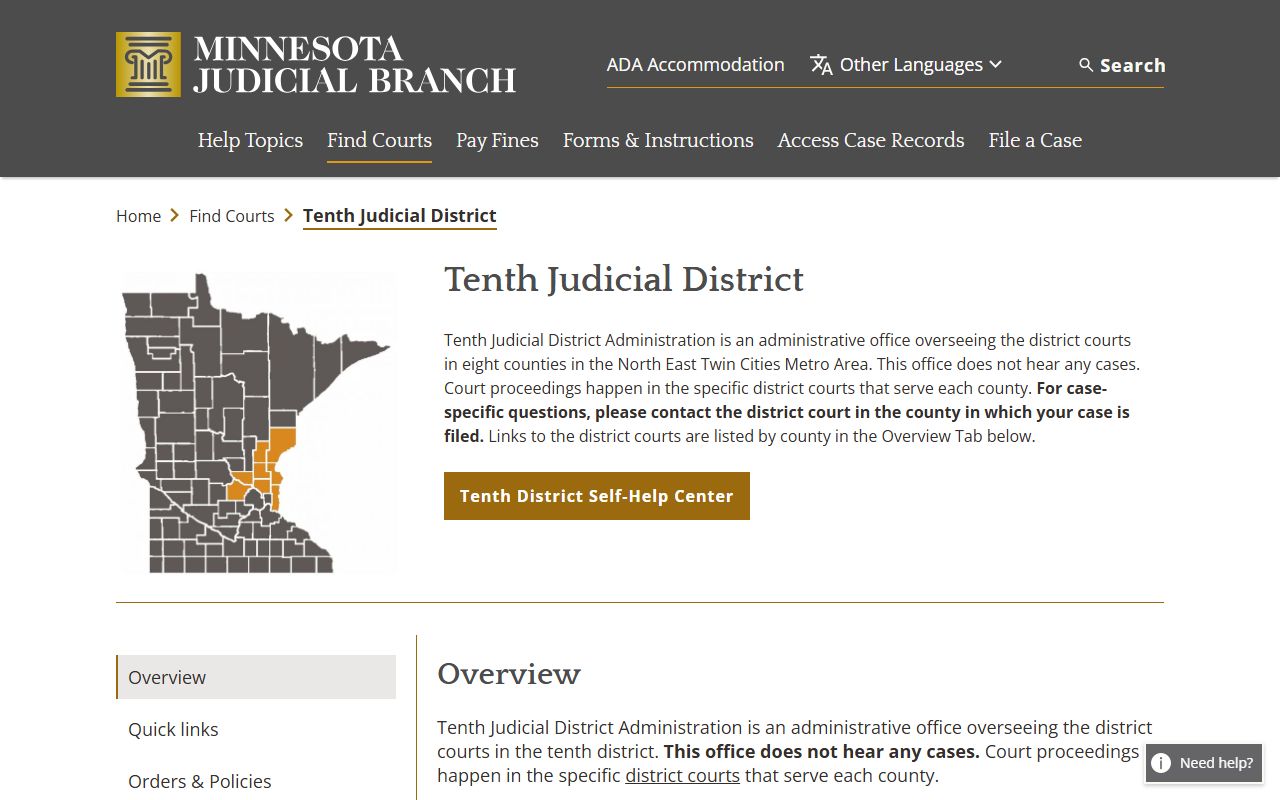
District administration sits at 7533 Sunwood Drive NW, Suite 306, in Ramsey, with the line 763-284-7260. The Chief Judge is Hon. Elizabeth H. Strand, and Sarah Lindahl-Pfieffer is the District Administrator. The district office supports the courts but does not hear cases; the county District Court does that work.
Conciliation Court and Lower-Level Matters
Minnesota does not use justice-of-the-peace or magistrate courts the way some states do. The closest equivalent to a small claims court is the Conciliation Court, a division of the District Court that hears smaller money disputes with simpler procedures. Many people handle a conciliation case without a lawyer, and the Self-Help Center can review the forms for completeness.
Payable traffic and petty matters route through the Criminal and Traffic Violations Bureau or to a hearing officer rather than a full courtroom. The traffic court records page covers that process in detail.
Note: Conciliation Court is the small claims division of the District Court, not a separate court, so filings and records still run through Court Administration.